WHAT IS RUBBER?
Rubber is a highly elastic, waterproof material that can be made synthetically from natural gas and petroleum or naturally from the sap of some tropical trees, such as the Hevea brasiliensis tree. Elasticity, toughness, and resilience are some of its primary qualities, which make it appropriate for a range of products, such as boots, tires, and other items. It can come in two different forms: Natural or Synthetic.
THE TWO FORMS OF RUBBER
Natural Rubber: The main source of natural rubber is the latex, a milky substance that is present in some plants, particularly the Pará rubber tree (Hevea brasiliensis). This latex, which is primarily composed of polymers of the organic chemical isoprene, specifically cis-1,4-polyisoprene, with trace amounts of proteins, fatty acids, and other contaminants, is obtained by creating incisions in the tree’s bark, a procedure known as “tapping.” Because of its remarkable elasticity, which allows it to stretch considerably and regain its original shape without permanently deforming, natural rubber is categorized as an elastomer. Natural rubber has strong mechanical and electrical insulating qualities and is waterproof and buoyant.

Synthetic Rubber: Creating synthetic rubber involves chemically joining polymer molecules, which are usually obtained from petroleum byproducts. It was created in the early 20th century to satisfy industrial demand that outstripped natural rubber supply. Compared to natural rubber, synthetic rubber frequently provides superior resistance to environmental elements like oils, heat, chemicals, and UV radiation.


Both natural and synthetic rubber are processed via vulcanization, a heat treatment that strengthens and stretches polymer chains by forming cross-links. Although too much heat might damage it, vulcanized rubber acts as a thermoset, maintaining its characteristics after cycles of heating and cooling.
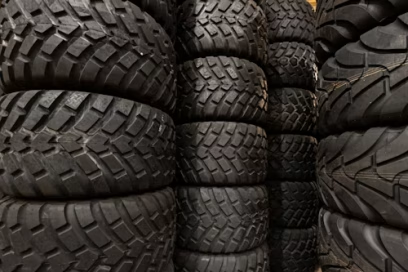
Numerous products, such as tires, hoses, gloves, footwear, medical equipment, adhesives, and numerous industrial parts, contain rubber. Its special qualities—such as electrical insulation, gas impermeability, flexibility, and abrasion resistance—make it essential in daily life and a variety of industries.
PRODUCTION PROCESS OF RUBBER
The production of rubber, whether natural or synthetic, involves several key stages that transform raw materials into usable products.
The production process of natural rubber is highlighted below:
- Tapping and Collection: Latex, a milky sap, is harvested from mature rubber trees (typically at least six years old) by making precise cuts in the bark. The latex flows into collection cups and is gathered for processing.
- Coagulation: The collected latex is treated with acids (commonly formic acid) to coagulate the rubber particles, forming solid lumps. This process usually takes about 12 hours.
- Rolling and Drying: The coagulated rubber is passed through rollers to remove excess water and form thin sheets. These sheets are then dried, often in smokehouses, to produce ribbed smoked sheets or air-dried sheets, depending on the method used.
- Shaping: The dried rubber is shaped into various forms depending on the intended application. Common shaping methods include extrusion, calendering, and molding.
- Vulcanization: The shaped rubber is subjected to vulcanization, a chemical process involving heat and sulfur (and sometimes accelerators). This step creates cross-links between polymer chains, enhancing elasticity, strength, and resistance to heat and chemicals.
- Finishing: The final products are trimmed, inspected, and packaged for distribution.
However, the production process of synthetic rubber is quite different. It is highlighted below:
- Polymerization: Synthetic rubber is produced from petroleum-based monomers (such as butadiene and styrene) through a chemical reaction called polymerization, forming long-chain polymers.
- Compounding: The synthetic rubber is mixed with additives (fillers, stabilizers, antioxidants, etc.) to achieve desired properties. This is typically done using roller mills or internal mixers.
- Shaping: Similar to natural rubber, shaping is done using extrusion, calendering, or molding techniques to form the material into the desired intermediate or final product.
- Vulcanization: The shaped synthetic rubber undergoes vulcanization, which cross-links the polymer chains to improve durability, elasticity, and resistance to environmental factors.
- Finishing: The finished products are processed, inspected, and packaged for use,
PROPERTIES OF RUBBER THAT MAKE IT VERSATILE
Rubber’s versatility comes from a special blend of its chemical and physical characteristics, which enable it to be used in many different sectors. The following are the main characteristics that make rubber versatile and practical:
- Elasticity and Flexibility: Rubber can stretch significantly – up to 300-800% of its original length, depending on the type – and return to its original shape without permanent deformation. This elasticity allows rubber to absorb shocks, vibrations, and mechanical stresses, making it ideal for products like tires, seals, gaskets, and flexible tubing.
- Durability and Abrasion resistance: Rubber withstands wear and tear from repeated use and friction, which is essential for applications exposed to harsh mechanical conditions. Its resistance to abrasion helps maintain performance and longevity in automotive parts, industrial seals, and protective gear.
- Water and Chemical Resistance: Many types of rubber, especially synthetic varieties like nitrile and EPDM (ethylene propylene diene monomer), resist water, oils, fuels, greases, and various chemicals. This makes rubber suitable for sealing, waterproofing, and industrial applications where exposure to liquids and chemicals is common.
- Temperature Resistance: Certain rubbers, such as silicone and EPDM, perform well under extreme temperatures, from very low to high, without losing their physical integrity. This thermal stability broadens rubber’s use in automotive, aerospace, and medical fields, where temperature fluctuations are frequent.
- Resilience and Compression Set Resistance: Rubber can absorb energy when deformed and quickly recover its original shape, which is crucial for dynamic seals and cushioning components. This resilience ensures that rubber products maintain their function even under continuous compression or bending.
- Electrical Insulation: Rubber is an excellent insulator, protecting against electrical shocks and enabling its use in electrical cables, connectors, and safety gloves.
- Customizability and Ease of Fabrication: Rubber can be manufactured in various forms – sheets, strips, foams – and easily cut or molded to specific shapes and sizes. This adaptability allows it to be tailored for specialized industrial, medical, or consumer products.
- Weather and Ozone Resistance: Some rubbers, like EPDM, resist degradation from ozone, UV light, and weathering, making them suitable for outdoor and automotive applications.
A Table that highlights Rubber Properties and Their Benefits
| Property | Description | Benefits/Applications |
|---|---|---|
| Elasticity & Flexibility | High stretchability and shape recovery | Tires, seals, gloves, flexible tubing |
| Durability & Abrasion Resistance | Withstands wear and friction | Automotive parts, gaskets, industrial seals |
| Water & Chemical Resistance | Impermeable to water, oils, fuels, chemicals | Waterproof seals, fuel hoses, chemical gloves |
| Temperature Resistance | Stable performance in extreme hot/cold conditions | Aerospace, automotive, medical devices |
| Resilience & Compression Set | Recovers shape after compression or deformation | Dynamic seals, cushioning, vibration dampers |
| Electrical Insulation | Non-conductive material | Electrical cables, safety gloves |
| Customizability | Easily fabricated and shaped | Custom seals, mats, industrial components |
| Weather & Ozone Resistance | Resistant to UV, ozone, and weathering | Outdoor seals, automotive weatherstripping |
Due to these combined qualities, rubber is used in a wide range of industries, from consumer items and medical devices to automotive and aerospace. Its widespread use and worldwide demand are supported by its special combination of flexibility, durability, resilience to chemicals and temperatures, and ease of customization.
Leave a Reply